Discussing Infrastructure in Performance at Cracks and Crossovers, School of Arts and Aesthetics, JNU

This past weekend I was invited to present my PhD research, Performing Distance: The Dramaturgy of Distance-Based Performances, which is my practice-based doctorate at the Royal Central School of Speech and Drama, at Cracks and Crossovers, the graduate conference organised by the School of Arts and Aesthetics at JNU in New Delhi. The organisers mentioned that they had received over four hundred abstracts, so I was glad to be among the thirty selected to present, and glad too that the conference had made room for practice alongside the paper.

Cracks and Crossovers is student-led, and its framing this year was an invitation to work on rupture as a method, moving beyond binaries and fixities to look at the discourses that emerge when marginalised subjectivities navigate dominant ideologies and spaces. Across three days it ran nine panels and two artist talks, opening with a keynote from Iram Ghufran on the disturbances and affordances of the unfolding documentary event, and it covered a wide spread of work, moving from bodies that matter and bodies of precarity through museums and archives, navigating the digital, counter-archives and embodied memory, stage and street and screen, and art and trauma and the spatial body, almost all of it presented by early career researchers, which made the room feel like an open space for discussion and solidarity.
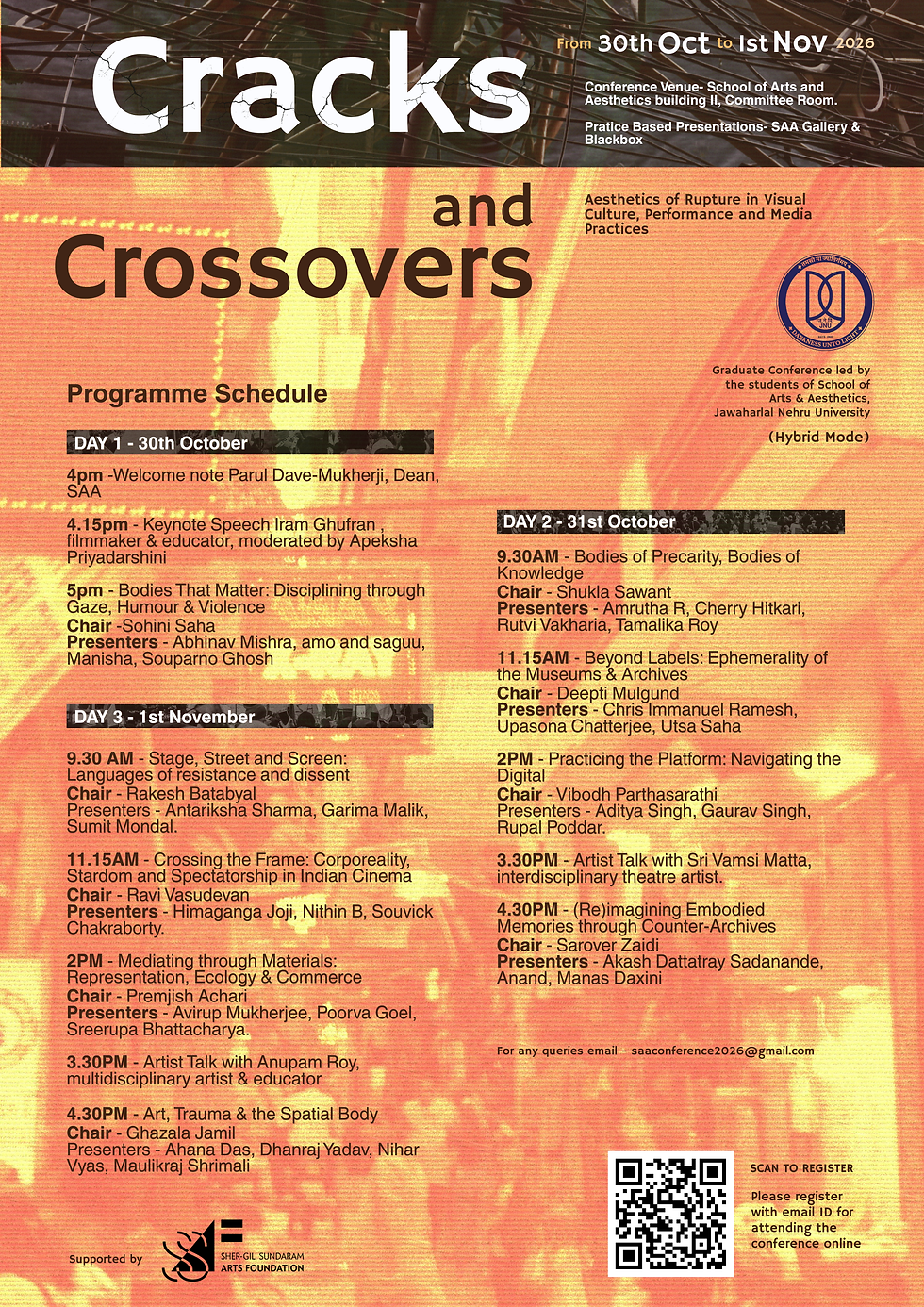
I presented on the second afternoon, on a panel called Practicing the Platform: Navigating the Digital, chaired by Vibodh Parthasarathi and facilitated by Rini Dasgupta, alongside Aditya Singh, who presented on queer pleasure and censorship on OTT and the changing conditions of watching, and Rupal Poddar, who presented on creative labour in microdrama. Three different objects, held together by a shared question about what platforms do to the work that gets made on them.

My paper was called "Hi, can you hear me?" and it comes out of the chapter of my thesis on infrastructural asymmetry, where I argue that the infrastructure which makes a performance across distance possible is not the context of that work but the material the work is made of. I took the argument through four productions, beginning with Station House Opera's At Home in Gaza and London, where the company had to source a generator because Gaza was living with twenty-hour power cuts, and where, as a performer from the production told me when I presented this material in September at Collisions, the company would shut down the lights in London whenever the electricity went in Gaza, so that the same thing was happening in both places at once. From there I moved to Rimini Protokoll's Call Cutta, which ran on the ordinary mobile network and on the much larger architecture of the outsourcing industry, and which is still described in the scholarship as a German production even though the labour that sustained it was and is in Kolkata, and then to two of my own works, Raum Raah, staged simultaneously in New Delhi and Bonn earlier this year, and Esteban's Village, a 2017 piece performed in Bombay by three of us scattered across Delhi, Guwahati and Pune.

What those four hold in common is that each borrowed an infrastructure built for something else, that the two ends of each connection were unequally equipped, that somebody was holding the line open at a cost which goes unnamed in the published accounts, and that these conditions reach the form, deciding what can be rehearsed, how long a scene can safely run, and who appears as a body while somebody else appears only as an image.


Because the conference held space for practice alongside papers, with installations, mixed media, photography and performance running through all three days, I was able to present the work twice, and the second version put a laptop on a table with a camera watching the room, surrounded by the phrases I have found myself saying to a machine over the last six years, the can you hear me now and the you're frozen and the please hold and the power just went. Where the paper asks can you hear me, a question sent out and waiting to be received, the installation answers with I see you, received and announced, so that one system is waiting to be heard while the other is announcing that it is watching, and both of them disappear while they are working and become legible only at the moment they strain.

The conversation after the panel was the most useful part of the day for me. Vibodh Parthasarathi asked what the risks might be of overlapping these infrastructures in the way I had been doing, and my answer, which I am still turning over, is that the risk is flattening. We also talked about wirelessness and about the promise that attaches to technology, and about whether what the field is currently calling an infrastructural turn might be more honestly described as an infrastructural return, since the discipline has circled this ground before, in the way it once moved between space and place, and remembering that earlier movement changes what any of us can claim is new. Rini Dasgupta then put a provocation to all three of us about speed, asking what these platforms actually do to modes of production and how that speed manifests in the work, and it was the question that held the panel together, because once it had been asked you could see it running through Aditya's account of what censorship does to the conditions of watching, through Rupal's account of creative labour compressed into seconds, and through my own material on latency and on the waiting that distance-based work is made of.

Three things are staying with me, and they are also where the chapter is heading. Infrastructures are designed to be hidden, which you could see in the room we were sitting in, where the cables had been carefully routed out of our sightline. They become visible at the point of rupture, whether that is a dropped call, a power cut, a frozen screen or a refused visa, and those are the moments when a system finally becomes readable, which is why I have come to treat them as data that tells us something. And infrastructure is dramaturgy, because what a performance can attempt is set by what holds it up, which means the generator, the wage differential and the visa belong inside the analysis and not in the acknowledgements.
My thanks to the organising team for putting together three days of this, to the students and staff of the School of Arts and Aesthetics at JNU for the welcome, my colleague Riddhijit Chattopadhyay for his documentation of my presentations, and to my supervisors Liam Jarvis and Kate Elswit for their constant support.


Comments