Bodies, Signals, Systems: Interactive Technology
Jul 2026
Lead Facilitator
An interactive and participatory workshop exploring how technology, digitality and AI can become part of contemporary artistic practice.
Bodies, Signals, Systems was an interactive and participatory workshop I developed for the resident artists of the Serendipity Arts Residency 2026 in New Delhi. The three-month residency is designed to support emerging practitioners working across contemporary art forms, providing them with time, space and curatorial support to develop new work or continue an existing line of artistic research. Now in its ninth edition, the residency brings together artists working across disciplines and encourages experimentation, critical inquiry, exchange and dialogue within a shared artistic community.
The 2026 cohort brought together artists with very different practices and approaches to making. Josefina Paz works across drawing, textiles, sound, installation and performance, exploring relationships between movement, territory, borders, identity and displacement. Kshetrimayum Gopinath Singh works primarily with oil painting, using marks, fragments and shifting spatial relationships to explore emotional and experiential states. Pratik Anil Sutar works through sculpture and material inquiry, drawing on inherited craft practices, labour and the relationship between memory and contemporary visual language. Nirmal Mondal works with ceramics and material experimentation, exploring the relationship between personal narrative, history, memory and objects. Vanshika Rathore approaches sculpture through sustained experimentation with materials including wood, clay, terracotta, glass, cement and found elements. Smiha Kapoor works across performance, sound, sculptural assemblage and participatory encounters, using embodied practice to explore questions of womanhood, displacement, agency and inheritance.
Working with such a diverse group was an important starting point for the workshop. Rather than approaching technology as a specialised discipline or asking artists to learn a particular software or technical system, I wanted to explore how technology might emerge from questions already present in their practices. We began by asking what technology actually means and looking at the many technologies artists already use, from the body, voice, thread, paintbrush and musical instruments to cameras, sensors, software and artificial intelligence.
The workshop introduced a simple framework of input, process and output, using it to think about how bodies, materials and environments can interact with systems. We explored possibilities across video, audio and sound, projection and mapping, sensors and physical computing, creative coding, and AI and machine learning. The session included discussions, pair exercises, practical experiments and individual conversations, allowing artists to consider how an interactive system might respond to their own materials, gestures, ideas or audiences. The workshop materials describe these as five broad territories of creative technology, with AI and machine learning introduced alongside them.
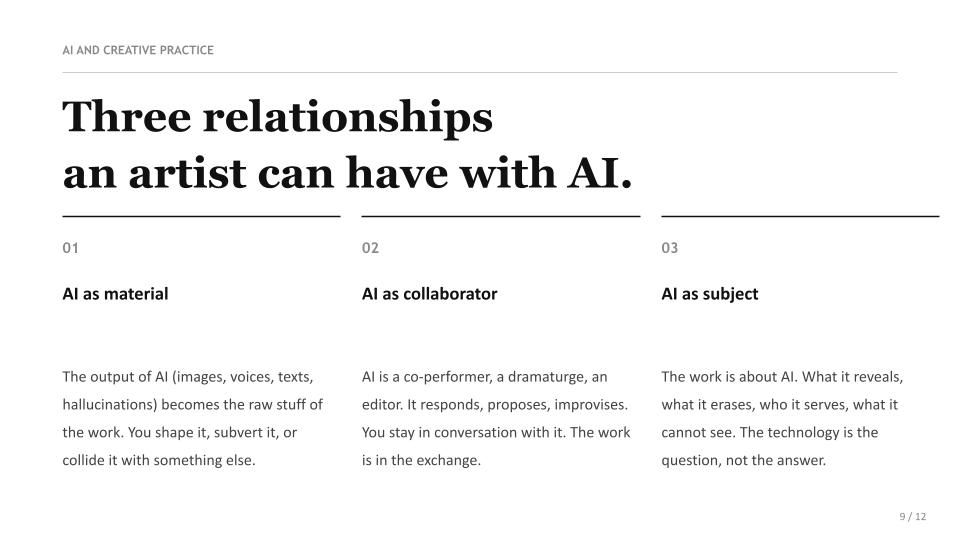
A significant part of the workshop was also about digitality and critical engagement with technology. We discussed what happens when embodied experiences become data, how technology can affect presence and participation, and what questions of ownership, authorship, bias and representation emerge when artists work with computational systems and AI. The aim was not to encourage technology for its own sake, but to ask a more useful question: which technology can help an artist say something, experience something or create a relationship that would otherwise be difficult to make?
The workshop also became a starting point for further experimentation within the residency. Following the session, several artists began incorporating interactive technology and media into their artistic processes. I continued working closely with Josefina Paz on the development of her interactive sonic installation, exploring how sound, physical interaction and technology could become part of her material and spatial practice.
I work with artists, cultural organisations, students and creative communities to develop workshops around digital practice, technology, creative tools and professional skills. Sessions can be delivered online or in person, and can take the form of a short talk, practical workshop, masterclass, intensive or longer training programme. I’m also happy to develop a session around the particular needs of your group. If you’re interested in organising something, get in touch.
_edited.jpg)
I developed Bodies, Signals, Systems as an interactive workshop for the resident artists of the Serendipity Arts Residency 2026. Bringing together artists working across painting, textiles, sound, sculpture, ceramics, installation and performance, the workshop explored how technology could extend existing artistic questions rather than become an end in itself. My approach was deliberately participatory and practice-led. Rather than beginning with software or technical skills, I began with the question: what is already responding to what in your practice? We looked at everything from the body, voice, thread and materials to sensors, cameras, code and AI as possible systems of input, process and output. The workshop combined group discussion, pair exercises, demonstrations and hands-on experiments. I wanted participants to leave not with a prescribed set of technologies to learn, but with a clearer sense of how technology might extend questions already present in their work.
Pedagogy
Thinking through technology: We began by questioning what counts as technology, looking at tools and systems already embedded in artistic practice.
Input · Process · Output: Artists mapped relationships between gestures, materials, sensors and other inputs and the transformations or outputs they could produce.
Practical experiments: Participants explored creative technology through accessible experiments with interactive systems, creative coding, AI and machine learning.
Reflection: Discussions considered digitality, data, liveness, participation, authorship and the social and political implications of technological systems.
Technologies & Possibilities
The workshop introduced five broad areas of creative technology: video; audio and sound; projection and mapping; sensors and physical computing; and creative coding, alongside an introduction to AI and machine learning. Examples included live cameras, contact microphones, binaural and spatial audio, projection mapping, Arduino and other sensors, p5.js, TouchDesigner, Teachable Machine and generative AI. The emphasis was not on mastering these tools, but on understanding how they might create new relationships between bodies, materials, audiences and systems.
Project Gallery