Accessibility for Artists
Dec 2022
Lead Facilitator
A workshop exploring accessibility as an integral part of artistic practice, production and audience development.
Accessibility for Artists was an online workshop facilitated by Gaurav Singh Nijjer for the Serendipity Arts Festival 2022, developed through Kaivalya Plays’ ongoing work around accessibility, audience development and inclusive artistic practice.
The workshop approached accessibility not as an additional service added at the end of a production, but as something that can be considered from the earliest stages of artistic and production planning. Participants were invited to examine who their work currently reaches, who they want it to reach, and what barriers might prevent different audiences and artists from participating.
The session moved through the different stages of an arts experience, beginning with production planning and communications, and extending through ticketing and programming, pre-experience access, the experience itself, post-experience engagement, audience development and artist development.
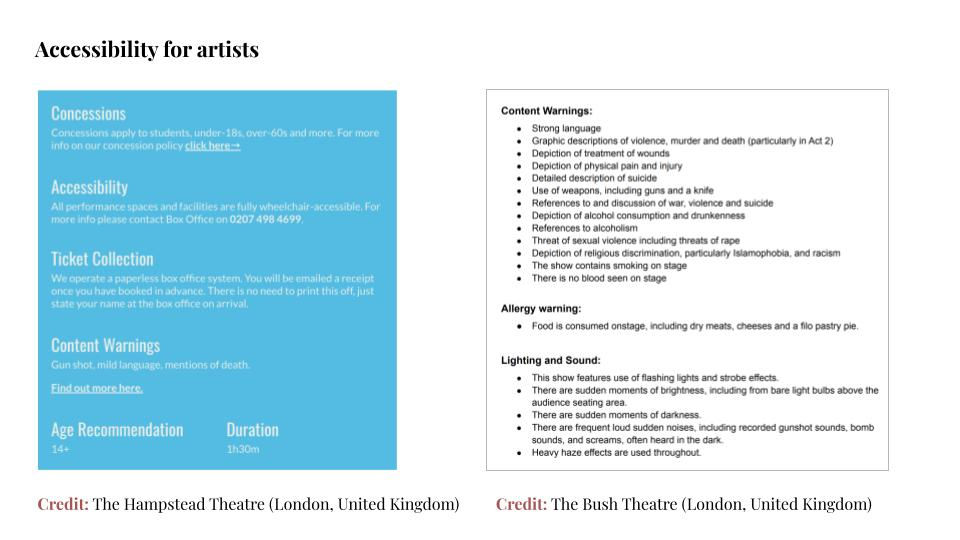
Participants were introduced to different approaches to accessible performance, including audio description, sign-language interpretation, captioning, subtitling, translation and touch-enabled experiences. The workshop also considered how accessibility information can be communicated clearly through event pages, content warnings, access information, accessible formats and different forms of communication.
A significant part of the workshop focused on risk assessment and access planning. Participants considered how apparently ordinary production decisions, from strong lighting and movement around a space to sensitive subject matter and venue infrastructure, can create barriers or risks for audiences and artists.
The workshop was deliberately practical. Through individual reflection and breakout-room activities, participants were asked to imagine different kinds of arts experiences they could offer their audiences and to think through potential barriers within an event. One activity invited groups to collaboratively plan an arts event while continuously identifying possible risks, turning accessibility and safety into part of the creative planning process rather than a separate checklist.
The session ultimately encouraged artists to think of accessibility as an ongoing practice of design, communication, participation and audience development, and to consider how small changes in the way work is conceived and presented can open it up to wider audiences.
_edited.jpg)
I designed and facilitated the workshop for Serendipity Arts Festival, drawing on Kaivalya Plays’ research and practice around accessibility in the performing arts. The session combined presentation, discussion, individual reflection and collaborative breakout-room exercises. My focus was on giving artists practical frameworks they could apply to their own productions, rather than treating accessibility as a purely institutional or technical concern.
Workshop Overview
Accessibility in Production Planning: Considering access from the earliest stages of developing an artistic project.
Communications: Making event and artistic information easier to access through clear descriptions, formats, languages and design.
Ticketing & Programming: Thinking about different entry points, performance formats and audience needs.
Accessible Performance: Introduction to audio description, sign-language interpretation, captioning, subtitling, translation and touch tours.
Risk Assessment: Identifying physical, sensory, environmental and content-related risks and barriers.
Audience Development: Understanding existing audiences and considering who is currently excluded or underserved.
Artist Development: Extending accessibility thinking to artists, performers and creative teams, not only audiences.
Learning Outcomes
Participants developed a practical understanding of accessibility as part of the entire artistic lifecycle, from conception and production to audience engagement and evaluation. They learned to identify potential barriers within their own projects, communicate access information more effectively, and consider different formats and modes of participation.
The workshop also encouraged participants to critically examine their existing audiences and identify who they would like their work to reach. Through practical exercises, participants developed strategies for incorporating accessibility into future artistic projects and began thinking about accessibility as an ongoing process rather than a one-time intervention.
Project Gallery