Interactive Screenplay Writing with Twine
Jul 2025
Lead Facilitator
A workshop for emerging filmmakers exploring interactive and non-linear storytelling through Twine.
I was invited by NIV Art Centre, New Delhi to serve as a mentor for the NIV Film Residency 2025, a programme supporting emerging filmmakers and their creative development. As part of the residency, I conducted a practical workshop on interactive and non-linear screenplay writing, introducing participants to ways of moving beyond the traditional linear screenplay and thinking about stories as systems of choices, possibilities and consequences.
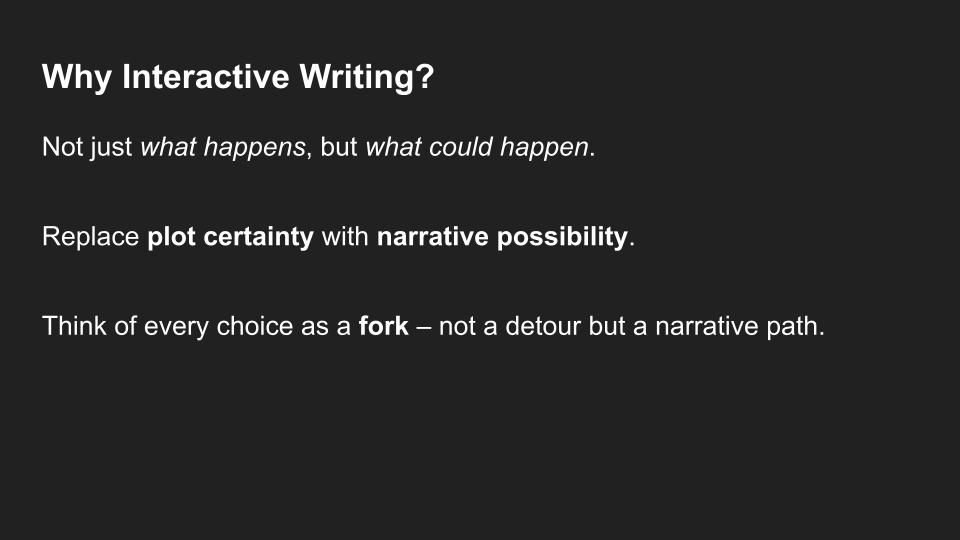
We began by asking a simple question: what happens when a screenplay does not have to follow a single path? Traditional screenplays generally establish a fixed sequence of events, while interactive writing creates space for audiences or users to make decisions that can alter the direction of a story. The workshop explored this shift from narrative certainty to narrative possibility, with particular attention to character choice and consequence.
The practical component centred around Twine, a free and open-source tool for creating interactive, nonlinear stories. Rather than treating it as a technical or programming exercise, I introduced Twine as a way of visualising and testing narrative structures. Participants worked with "passages" as building blocks similar to screenplay scenes, using them to create branching dialogues, decisions, moral dilemmas and alternative narrative paths. The workshop did not require prior coding experience.
Participants first created a simple scene involving a single character and developed three possible choices for that character. We then considered what each choice might reveal about the character, and how different decisions could lead to different emotional, ethical or narrative consequences. In a second exercise, participants took one of their choices and expanded it into further branches, thinking through possibilities such as action, emotion, consequence and environment.
A central concern of the workshop was character agency. Instead of asking only what happens next, participants were encouraged to ask what a character could do, what they want, what choices are available to them, and what each choice changes. Flowcharts became a way of thinking through multiple narrative arcs, while the interactive structure allowed participants to rehearse uncertainty within their stories.
The workshop also introduced a broader way of thinking about interactive storytelling. Twine can shift some control from the author towards the story system and, ultimately, towards the audience. This creates possibilities for ambiguity, agency and discovery, allowing the audience to participate in constructing the experience rather than simply receiving a predetermined sequence of events.
My aim was not to suggest that every screenplay should become interactive, but to give filmmakers another way of thinking about narrative structure. By temporarily replacing the certainty of a linear plot with a network of possible choices, writers can discover new relationships between character, consequence, audience and story.
I work with artists, filmmakers, students and creative communities to develop workshops around storytelling, digital practice, creative technology and professional skills. Sessions can take the form of short talks, practical workshops, masterclasses, intensives or longer training programmes, and can be delivered online or in person. I’m happy to develop a session around the particular needs of your group. If you’re interested in organising something, get in touch.
_edited.jpg)
I designed and facilitated this workshop as part of my role as a mentor for the NIV Film Residency 2025. My approach combined narrative discussion with hands-on experimentation. Rather than teaching Twine as a piece of software in isolation, I used it as a tool for writers to make their narrative structures visible and test what happens when characters are given genuine choices. The workshop moved between examples, discussion, individual writing exercises and group sharing, allowing participants to develop and extend their own interactive scenes.
Workshop Overview
Interactive vs Linear Writing: Exploring the difference between a fixed narrative path and a story built around choices and possibilities.
Branching Narratives: Using choices as narrative forks rather than detours, and mapping multiple possible story paths.
Twine: Introduction to the free, open-source Twine platform and its use of passages as building blocks for nonlinear stories.
Character Choice: Asking what characters want, what choices they have and how different decisions reveal character.
Consequences: Exploring the emotional, ethical and narrative consequences of different choices.
Interactive Structures: Using flowcharts and branching structures to develop and visualise multiple narrative arcs.
Learning Outcomes
Participants developed an understanding of how interactive and nonlinear storytelling can expand conventional screenplay structures. They learned to identify opportunities for branching narratives, map character choices and develop consequences across multiple story paths. Through practical exercises with Twine, participants created and extended their own interactive scenes without requiring prior programming experience.
The workshop also encouraged participants to think about audience agency, ambiguity and the relationship between authorial control and audience participation, and to consider how interactive structures might reveal new possibilities within their existing writing practices.
Project Gallery